
India’s Water Economy
Securing Growth Through Smarter Water Management
Why Storage is the Root Cause :
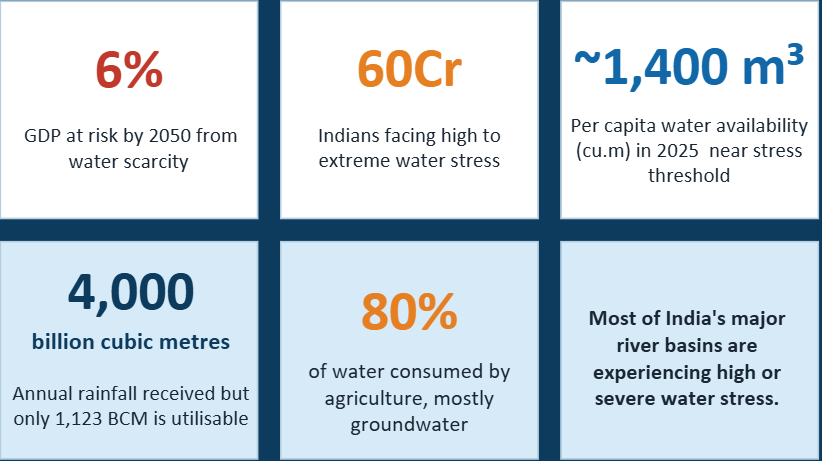
• India stores ~30-40 days’ worth of water supply
• Developed water economies store 900-1,000 days’ worth
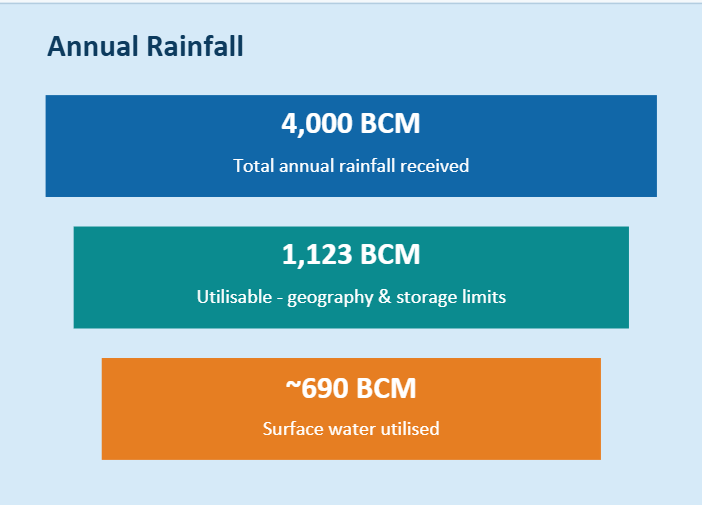
• Total major reservoir capacity: ~257 BCM vs 4,000 BCM annual rainfall
• Monsoon concentration (70% rainfall in June-Sept) means storage is critical
• 11 of 15 major river basins approaching severe stress
Surface Water: Reservoir Stress in 2026
The average reservoir capacity was less than forty-five percent across one hundred and sixty-six monitored reservoirs.
Of these, thirteen were major reservoirs, with reservoir levels below fifty percent of their capacity as of mid-May 2026.
Groundwater: The Invisible Crisis
India extracts 25% of the world’s groundwater
India has approximately 239 billion cubic metres (BCM) of groundwater resources.
The country has the world’s highest annual groundwater extraction.
Approximately 87% of the extracted groundwater is used for agriculture.
The Governance Trap
- Free/subsidised electricity for pumping → over-extraction is economically rational for farmers
- MSP for water-intensive crops (paddy, sugarcane) → no price signal for water conservation
- Punjab/Haryana: pumping costs now exceed net returns – yet extraction continues
- Solar irrigation pumps reduce electricity costs but risk accelerating depletion without usage caps
- Depletion may reduce cropping intensity by up to 68% in most-stressed regions
Jal Jeevan Mission: Rural Water Transformation
From 3.23 crore to 15.72 crore connections in 6 years
Key Milestones :
• 11 States/UTs at 100% coverage (Goa, Gujarat, Haryana…)
• 9.23L schools & 9.67L Anganwadi centres with tap water
2,843 water testing laboratories support nationwide water quality monitoring
• 24.8L women trained on Field Testing Kits
• ₹67,000 Cr allocated in Budget 2025-26
• Focus shifts from connections → service delivery quality
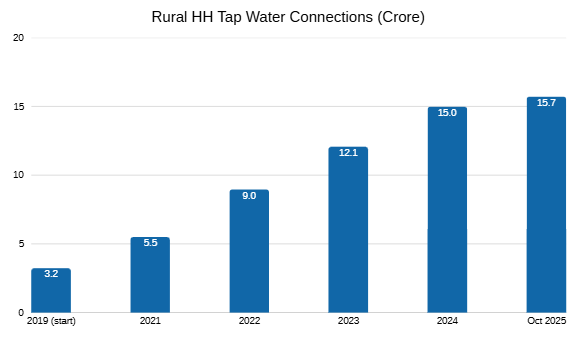
Out of the total rural households, 81% equivalent to 15.72 crore households are now covered, with the remaining 19% still to be covered.
Agricultural Water: Reform Imperative
Agriculture uses 80% of India’s water – reform here matters most
The Problem
- 239 BCM groundwater extracted annually
- 87% goes to irrigation – mostly flood irrigation
- In Punjab, canal irrigation supplies only about one-third of irrigation needs, increasing dependence on groundwater.
- MSP for paddy/sugarcane drives water-intensive choices
- Electricity subsidies eliminate price signal for water
Govt Response 2025-26
- ₹32,000 Cr (VB-GRAMG) for water conservation & dark zone revival
- PMKSY: Har Khet Ko Pani – irrigation expansion + Per Drop More Crop
- 1.42 Cr artificial recharge structures targeted (MoJS master plan)
- Over 20 States/UTs have adopted or aligned legislation based on the Model Groundwater Bill.
Proven Solutions
- Tensiometer irrigation: 13% water saved, 7% cost cut, no yield loss (Punjab)
- Paani bachao paisa kamao: farmers paid to save water, early results positive
- Crop diversification pilots, farmers willing if procurement guaranteed
- Studies suggest a 20% improvement in irrigation efficiency could significantly slow groundwater depletion.
- Solar pump + smart metering + usage caps = efficient + sustainable
The Economic Opportunity: Smart Water Management
(A $2.26Bn market by 2034 – growing at 11.34% CAGR)
$837M – Smart water management market value in India in 2025
11.34% – CAGR projected for 2026–2034, making it one of the fastest-growing infrastructure segments
$2.26Bn – Projected market size by 2034
What ‘Smart Water’ Includes
- Digital meters & IoT sensor networks
- SCADA for real-time monitoring & control
- GIS-integrated asset management
- AI-powered leak detection & predictive maintenance
- Water quality monitoring & analytics
- Smart irrigation scheduling & water accounting
Five Recommendations: Towards a Smarter Water Economy
Reform the Energy Water Agriculture Nexus – Replace electricity subsidies for pumps with direct income transfers; diversify MSP to reduce water-intensive crop dominance; scale the Paani Bachao pilot into a national water savings incentive scheme.
Establish Integrated River Basin Authorities – Statutory authorities for all 15 major basins with real allocation, pricing, and enforcement powers. Model on Murray-Darling Basin Authority, adapted to India’s constitutional framework.
Mandate and Finance the Circular Water Economy – National target: 50% of treated wastewater reused by 2035. Mandatory industrial reuse requirements. AMRUT 2.0 scale-up for tertiary treatment. Price treated water to create a functioning supply market.
Invest in Smart Water Infrastructure – Mandatory digital metering in urban utilities. SCADA integration standard for all new water projects. JJM RPWSS digital registry as the rural monitoring backbone. AI-powered leak detection at scale.
Complete JJM with a Service Delivery Focus – Target 100% coverage by 2028 with binding state MoUs. Shift incentives from connections to reliable hours of supply. Scale Maharashtra’s women-led SHG O&M model nationally.
India’s water economy is at an inflection point – more urgent and more manageable than commonly recognised.
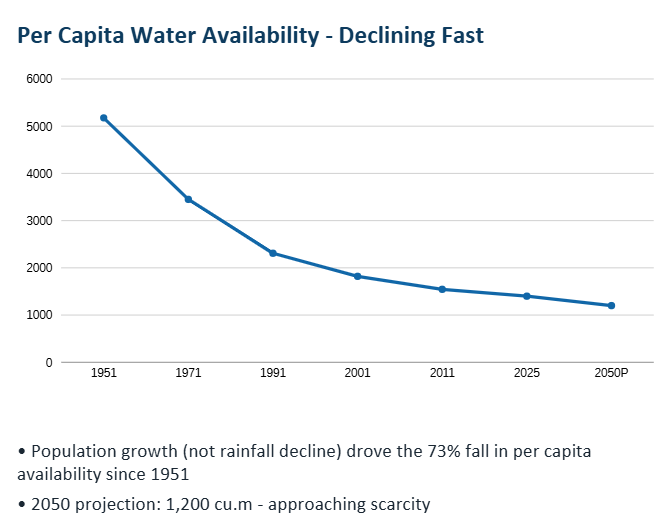
More urgent: per capita availability approaching scarcity; 11/15 basins stressed; aquifer depletion approaching irreversibility
More manageable: It was proved large-scale water delivery is possible; smart water market growing at 11% CAGR; global solutions proven
The gap is governance: energy-water-agri subsidies, institutional fragmentation, O&M deficits, not technology or funding alone
Government Priorities Driving India’s Water Economy
Jal Jeevan Mission (JJM) 2.0 – Ensuring reliable and safe rural drinking water services. Strengthening water quality monitoring and village-level maintenance. Promoting source sustainability and groundwater recharge.
Viksit Bharat Gramam Abhiyan (VB-GRAMG) – Promoting rainwater harvesting and watershed development. Supporting groundwater recharge and revival of water-stressed areas. Encouraging community-led water conservation.
AMRUT 2.0 – Improving urban water supply infrastructure. Expanding sewage treatment and wastewater reuse. Encouraging smart water management and leak reduction.
Artificial Groundwater Recharge Master Plan – Building recharge structures to replenish groundwater. Promoting check dams, recharge wells and farm ponds. Enhancing long-term groundwater availability.
PM Krishi Sinchayee Yojana (PMKSY) – Expanding irrigation coverage across agricultural regions. Supporting drip and sprinkler irrigation through subsidies. Promoting efficient water use under the Per Drop More Crop initiative.
Atal Bhujal Yojana – Strengthening community-led groundwater management. Preparing Village Water Security Plans. Promoting groundwater monitoring and water budgeting.
National Aquifer Mapping (NAQUIM) – Mapping groundwater resources across India. Supporting scientific groundwater planning. Identifying priority areas for aquifer recharge.
Namami Gange Programme – Restoring river ecosystems through pollution control. Expanding sewage treatment infrastructure. Promoting treated wastewater reuse.