
2026 Market Landscape, Government Policy & Water Sustainability
India’s Data Centre Market at a Glance – H1 2026
~1.-1.9 GW Operational data-centre capacity, H1 2026
~147 Data centres operated by 33 providers
14.9% Colocation vacancy rate, H1 2026
3.86 GW Additional capacity expected by 2030
~100 MW H1 2026 absorption
~US$29.9B Development capital required through 2030
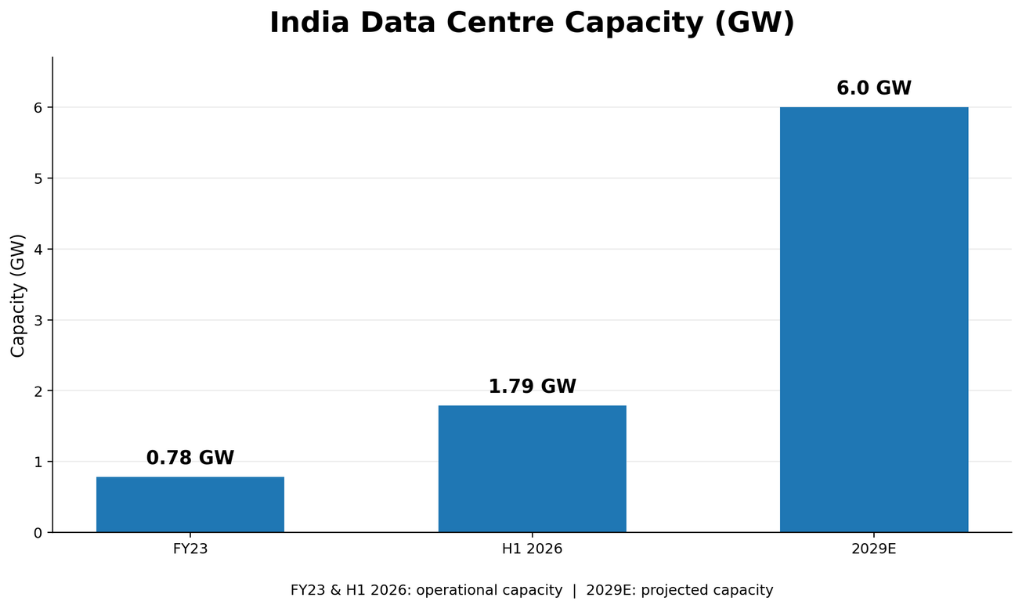
India’s Data Centre Capacity Is Set to Triple by 2029
India’s data-centre capacity has grown from ~0.78 GW in FY23 to ~1.8 GW by H1 2026. Capacity is projected to reach ~6 GW by 2029, while a further 3.86 GW of supply is currently under construction or planned through 2030.
US$110B – Investment required to reach ~6 GW by 2029
US$29.9B – India’s projected development capital requirement through 2030
3,860 MW – Additional supply expected through 2030 509 MW under construction | 3,351 MW planned
Hyperscalers and Conglomerates Are Betting Big
- Adani Group ($100B by 2035)
Renewable-powered, hyperscale AI-ready data centres; integrated power and grid infrastructure
- Reliance / Digital Connexion ($11B by 2030)
1 GW AI-native data-centre campus in Visakhapatnam, with Reliance Industries, Brookfield & Digital Realty
- Amazon (AWS) (US$48B by 2030)
US$13B additional investment in AI and cloud infrastructure, including AWS data-centre capacity
- Microsoft ($17.5B by 2029)
AI and cloud infrastructure, hyperscale data centres, skilling and operations
- Google ($15B over 5 yrs)
Gigawatt-scale AI hub in Visakhapatnam, Andhra Pradesh, with AdaniConneX and Airtel
- OpenAI + Tata Group (100 MW → 1 GW)
AI-ready data-centre capacity through TCS HyperVault
Adjacent Schemes That Also Shape the Sector
| Scheme | What It Does | Relevance to Data Centres |
| PLI 2.0 for IT Hardware | ₹17,000 crore scheme supporting domestic manufacturing of laptops, tablets, all-in-one PCs, servers and ultra-small form-factor devices. | Supports domestic manufacturing of servers and other IT hardware used in data-centre infrastructure, strengthening the local supply ecosystem. |
| Electronics Components Mfg. Scheme | Scheme to develop domestic manufacturing of electronic components and sub-assemblies. Its outlay was increased from ₹22,919 crore to ₹40,000 crore in Budget 2026-27. | Supports the broader electronics supply chain relevant to IT hardware and connectivity, including PCBs, optical transceivers, electro-mechanical components and other components used across the technology ecosystem. |
| PM Gati Shakti | Integrated infrastructure-planning framework launched in October 2021 to improve multimodal connectivity to economic zones through coordinated infrastructure planning. | Can indirectly support data-centre development by improving infrastructure planning, connectivity and access to economic zones, although it is not a data-centre-specific policy. |
| GIFT City / IFSCA | Budget 2026-27 proposed extending the deduction for eligible IFSC units to 20 consecutive years out of 25 years, subject to applicable conditions. | Strengthens the GIFT IFSC financial-services ecosystem, which can contribute to demand for local digital, cloud and data infrastructure. |
| RBI Data Localisation (2018) | Requires payment-system providers to store the entire data relating to payment systems in India; data relating to the foreign leg of an international transaction may also be stored abroad if required. | Creates a regulatory driver for India-based data-storage infrastructure for payment-system data and therefore supports demand for compliant domestic data-centre capacity. |
State-Level Policies Are Shaping India’s Data Centre Landscape
| STATE | POLICY | SIGNATURE INCENTIVE |
| Tamil Nadu | Data Centre Policy 2021 policy period ended 31 Mar 2026 | Stamp duty & fiscal incentives, dual power, industrial electricity tariff, green-energy provisions |
| Telangana | Data Centres Policy 2016 | Subsidised land, power incentives, building-fee rebates, R&D and patent support |
| Uttar Pradesh | Data Centre Policy 2026 | AI/green incentives, capital & land subsidies, electricity-duty exemption, dual-grid and renewable-energy support |
| Karnataka | Data Centre Policy 2022-2027 | Single-window clearance, dual-grid power, water and infrastructure facilitation |
| Maharashtra | IT & ITES Policy 2023 | Data-centre parks, single-window approvals, infrastructure and green-power support |
| Odisha | Data Centre Policy 2022 | Infrastructure/power support, fiscal incentives and manufacturing ecosystem |
| Haryana | Data Centre Policy 2026 | Single-window approvals, power/infrastructure support, investment incentives and essential-service framework |
| Rajasthan | Data Centre Policy 2025 | Investment incentives, renewable-energy support, relaxed building norms and sustainability provisions |
Mumbai Leads, Chennai Accelerates Fastest
Mumbai (~50% of operational capacity 890 MW operational capacity; India’s largest data-centre market.)
Chennai (~12% of operational capacity 214 MW operational capacity, with 50% of H1 2026 new supply additions according to JLL.)
Hyderabad (~8% of operational capacity 151 MW operational capacity, with a substantial future pipeline.)
Bengaluru (~9% of operational capacity 162 MW operational capacity, supported by its technology ecosystem.)
Delhi NCR (~10% of operational capacity 183 MW operational capacity; a major northern data-centre market.)
Pune (~7% of operational capacity 133 MW operational capacity, with 258 MW of upcoming supply in the C&W pipeline.)
Ahmedabad – GIFT City (Emerging financial and digital-infrastructure hub. Growing financial-services activity in GIFT IFSC is creating an ecosystem relevant to digital and data infrastructure.)
Noida (Multiple large-scale facilities and planned developments are strengthening the NCR market; it is better treated as part of Delhi NCR rather than as a separate national market.)
How Indian Data Centres Manage Water
Water is becoming an increasingly important consideration alongside power when planning and designing data centres, particularly as AI and high-density computing increase cooling requirements. Operators are responding through three broad levers: reduce water demand, recirculate cooling fluids, and increase the use of treated/recycled water. Water Usage Effectiveness (WUE), measured in litres of water consumed per kWh of IT equipment energy, is the established metric for tracking operational water efficiency.
Closed-loop & liquid cooling – Direct-to-chip, rear-door heat exchangers and immersion cooling use recirculating cooling systems that can reduce reliance on evaporative cooling. These technologies are becoming increasingly relevant as AI and high-performance computing drive higher rack power densities.
Zero Liquid Discharge (ZLD) – Treatment and reuse of cooling-tower blowdown can reduce freshwater demand and wastewater discharge. Rajasthan’s 2025 Data Centre Policy promotes green and environmental solutions and provides incentives for eligible projects, although it should not be described as imposing a blanket ZLD requirement on data centres.
Treated & recycled water sourcing – Data-centre operators can reduce dependence on freshwater by using appropriately treated wastewater for non-potable applications such as cooling-tower makeup, where local infrastructure, water quality and regulatory requirements permit. A 2024 draft Liquid Waste Management framework proposed treatment and progressive wastewater-reuse obligations for bulk water users consuming more than 5,000 litres per day.
Regulatory guardrails – Data centres using groundwater are subject to applicable groundwater-regulation and NOC requirements. MeitY’s 2026 clarification references the Central Ground Water Authority’s 2020 groundwater guidelines and 2023 amendment, while environmental approvals can also consider water availability, water balance, wastewater generation, recycling and reuse.
Water in Context: Small Share, Real Transparency Gaps
0.02-0.03% – Share of India’s total water demand estimated to be attributable to data centres, according to CEEW’s 2026 analysis. CEEW estimates annual data-centre water use at approximately 150 billion litres, compared with around 78-80% of water demand accounted for by agriculture.
WUE varies significantly by facility and cooling technology – STT GDC India reported 0.58 L/kWh in FY25, a 56.2% improvement from its FY21 baseline of 1.34 L/kWh. WUE is not yet reported consistently across operators, making cross-company comparisons difficult.
Where Scrutiny Remains
- Disclosure remains inconsistent: Not all operators publicly report WUE, while available disclosures can lack consistent methodology, facility-level detail and water-source information.
- Water-neutrality claims require scrutiny: Claims based on recycling, replenishment or offsetting should be assessed based on their boundaries, methodology and independent verification.
- Localised water stress matters: Although data centres represent a small share of national water demand, their concentrated water requirements can create greater pressure in water-stressed locations.
AI Workloads Are Changing How Data Centres Are Built
Bigger blocks – Data-centre project sizes have expanded from around 20 MW to 50+ MW blocks, reflecting the need to accommodate larger, high-density AI and GPU computing clusters.
Pre-committed hyperscale demand – Pre-committed hyperscale capacity accounted for 82% of India’s H1 2026 data-centre absorption (101 MW), primarily driven by high-density AI computing workloads.
Sovereign compute push – The IndiaAI Mission has expanded shared AI compute capacity to 45,000+ GPUs as of June 2026, providing subsidised access to startups, researchers and institutions. The government is continuing to expand domestic AI computing infrastructure.
Liquid & high-density cooling – AI and GPU workloads increase rack power density and heat loads, accelerating the adoption of direct-to-chip liquid cooling, immersion cooling and advanced thermal-management systems. High-density deployments also require power and cooling infrastructure designed for greater loads and resilience.
Execution Risk Sits on Power, Land and Grid
Power availability – Power availability, reliability and cost are increasingly important factors in data-centre siting, particularly as AI and high-performance computing increase electricity demand. AI deployments also require substantially higher rack power densities than conventional enterprise workloads.
Land & clearances – Large, power-ready land parcels are becoming harder to secure in established data-centre markets, pushing developers toward emerging locations. Land acquisition, infrastructure readiness and regulatory approvals can materially affect project timelines. Government is working to address these constraints through DC-ready land banks, single-window approvals and streamlined building regulations.
Grid & transmission readiness- Rapid data-centre capacity additions need to be matched by transmission capacity, substations and reliable grid connections. Government discussions in 2026 have highlighted cluster-based transmission and substation planning, Day-1 sanctioned load and dual power feeders as important requirements for large data-centre developments.
Policy fragmentation – India’s data-centre regulatory environment remains multi-layered, with states offering different incentives, land provisions, power-related measures and approval frameworks. The national Draft Data Centre Policy 2020 was never implemented as a final policy in its original form, while subsequent national policy proposals and state-level initiatives have continued to evolve. This makes location-specific policy comparison important for developers.
Central Government Policy & Initiatives
Tax holiday to 2047 – Budget 2026-27 proposes a tax holiday up to 2047 for eligible foreign companies providing services globally by procuring data-centre services in India. Services to Indian users would be provided through an Indian reseller entity, with a 15% safe-harbour margin proposed for qualifying related-party data-centre service arrangements.
IndiaAI Mission – ₹10,372 crore five-year outlay to build India’s AI ecosystem. More than 38,000 GPUs have been onboarded under the common compute facility and are being offered to eligible startups and academia at a subsidised rate of around ₹65 per GPU-hour.
India Semiconductor Mission 2.0 – ₹1,27,500 crore total outlay, approved in July 2026, building on Semicon 1.0. The programme expands support across chip design, semiconductor equipment and materials, fabrication, advanced packaging, R&D and talent development.
BIS data centre standards – BIS has adopted the IS/ISO/IEC 30134 series of data-centre key performance indicator standards, covering metrics including PUE, WUE, CUE and CER. LITD 31 is the BIS committee/project focused on data-centre infrastructure.
DPDP Act Rules – The Digital Personal Data Protection Rules, 2025 were notified in November 2025, operationalising the DPDP Act, 2023 through a phased implementation. The framework adopts a negative-list / “blacklist” approach to cross-border personal-data transfers rather than blanket data localisation, while allowing stricter requirements under other Indian laws to continue.