
India’s Shipbuilding Industry
Can India Become a Global Maritime Manufacturing Hub?
Executive Summary
India’s shipbuilding sector stands at a pivotal inflection point. After decades of minimal commercial presence, the country is now mobilising unprecedented financial firepower and forging high-profile global partnerships to claim a seat at the world’s maritime manufacturing table.
India is seeking to transform its shipbuilding industry from a relatively small domestic sector into a globally competitive manufacturing industry that supports economic growth, maritime security, exports, and industrial development. This ambition forms part of the Government of India’s broader maritime strategy under Maritime India Vision 2030 and the long-term Amrit Kaal Vision 2047, which aim to strengthen the country’s role across ports, shipping, logistics, shipbuilding, and maritime services.
Globally, commercial shipbuilding remains highly concentrated. China, South Korea, and Japan together account for the overwhelming majority of commercial shipbuilding output and orderbooks, supported by decades of investment, integrated supply chains, technological leadership, and government support. Entering this market therefore requires sustained investment, technological capability, skilled labour, competitive financing, and policy stability.
India begins from a comparatively modest base but possesses several structural advantages. It has a coastline exceeding 7,500 km, a strategically important location along major east-west shipping routes, one of the world’s largest steel industries, a large engineering workforce, established naval shipbuilding capabilities, and the world’s largest ship recycling ecosystem by volume in recent years. These strengths provide a foundation for expanding both commercial and defence shipbuilding.
The Global Maritime Economy – Understanding the Industry Before Understanding India
Global Trade
- Around 80% of global merchandise trade (by volume) is transported by sea.
- Maritime transport connects global supply chains and enables international commerce.
- Major cargo includes oil, LNG, iron ore, coal, grain, and containerized goods.\
Shipping Industry
- The global fleet includes bulk carriers, tankers, container ships, LNG carriers, and offshore vessels.
- Ships typically operate for 20-30 years, making shipping a capital-intensive industry.
- Freight markets fluctuate due to long shipbuilding lead times.
Maritime Logistics
- Maritime logistics integrates shipping, ports, warehousing, customs, and inland transport.
- Containerization and digital technologies have improved speed, efficiency, and cost.
Shipbuilding Economics
- Shipbuilding supports industries such as steel, engineering, electronics, and marine equipment.
- China, South Korea, and Japan dominate global commercial shipbuilding.
Fleet Replacement Cycle
- Ships are replaced every 20-30 years due to aging, fuel efficiency, and environmental regulations.
- The global push for cleaner vessels is accelerating fleet renewal.
IMO Decarbonisation
- Shipping accounts for about 3% of global GHG emissions.
- The IMO aims for net-zero emissions by or around 2050.
- Investments are increasing in cleaner fuels and energy-efficient ships.
LNG Transition
- LNG is the leading transition fuel for shipping.
- It reduces SOx, NOx, particulate matter, and CO₂ compared to conventional fuels.
- Approximately one-third of new vessel orders are capable of operating on LNG.
Container Shipping
- Container shipping carries most manufactured goods traded globally.
- Demand is driven by economic growth, e-commerce, and global manufacturing.
Offshore Sector
- Supports offshore oil & gas, wind energy, subsea cables, and marine infrastructure.
- Growth in offshore renewables is increasing demand for specialized vessels.
Global Shipbuilding Industry
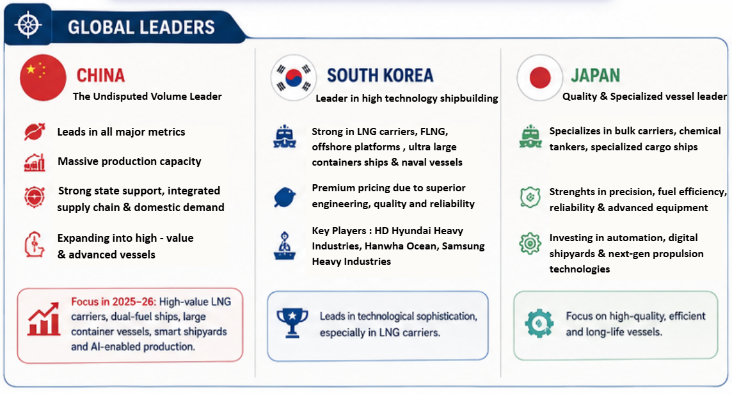
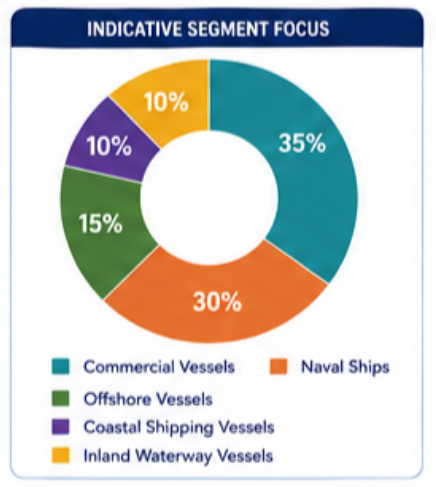
The global shipbuilding industry is in a strong upcycle, driven by rising trade, fleet renewal, decarbonization regulations and geopolitical shifts. Orderbooks are at multi-year highs, with major shipyards booked well into 2028-2030.
Shipbuilding as an Industrial Multiplier
Shipbuilding is widely recognised as one of the most strategically important manufacturing industries due to its extensive linkages with multiple sectors of the economy. Often referred to as the “mother industry of heavy engineering,” it generates demand across steel, heavy engineering, electrical equipment, marine electronics, automation, logistics, and defence manufacturing while creating large-scale employment and strengthening India’s MSME ecosystem.
Recognising its strategic importance, the Government of India approved approximately ₹69,000 crore maritime package announced in the Union Budget 2025 to strengthen domestic shipbuilding, maritime financing, and port infrastructure.
Impact on the Steel Industry
Steel is the primary raw material used in shipbuilding, with marine-grade steel, high-tensile steel, forgings, castings, pipes, and fabricated structures forming the backbone of every vessel. Expansion of domestic shipbuilding is expected to significantly increase demand for specialised steel products, supporting India’s steel industry while promoting greater domestic value addition and reducing dependence on imports.
Impact on Heavy Engineering
Shipbuilding is a major consumer of heavy engineering products, including propulsion engines, gearboxes, shafts, propellers, pumps, compressors, cranes, hydraulic systems, boilers, and valves. A growing shipbuilding sector strengthens India’s heavy engineering capabilities by encouraging investment in precision manufacturing, industrial equipment, and advanced mechanical systems.
Impact on Electrical Equipment
Modern ships require highly sophisticated electrical systems for power generation, distribution, navigation, and safety. Increased shipbuilding activity creates demand for marine switchboards, transformers, power distribution systems, cables, batteries, electrical panels, and integrated control systems. The transition towards hybrid-electric and electric vessels is expected to further accelerate demand for advanced electrical technologies.
Impact on Marine Electronics
Digitalisation is transforming ships into highly connected technology platforms. Modern vessels rely on advanced radar systems, navigation equipment, satellite communications, sensors, integrated bridge systems, cybersecurity solutions, and automated monitoring systems. Defence vessels additionally require combat management systems, electronic warfare equipment, and secure communication technologies, creating significant opportunities for India’s marine electronics industry.
Impact on Automation Systems
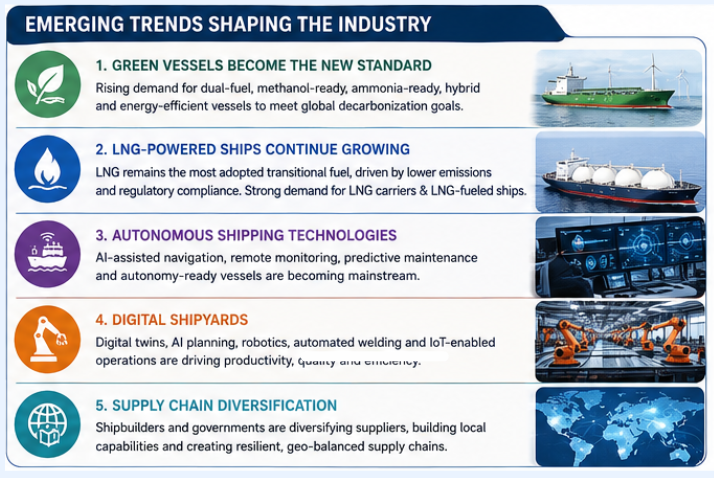
The shipbuilding industry is increasingly adopting Industry 4.0 technologies such as Artificial Intelligence (AI), robotics, Industrial Internet of Things (IIoT), digital twins, automated welding, predictive maintenance, and smart production planning. These technologies improve productivity, reduce construction timelines, enhance quality, and strengthen the global competitiveness of Indian shipyards.
Impact on Defence Manufacturing
Shipbuilding plays a vital role in strengthening India’s defence industrial base. Indigenous construction of aircraft carriers, destroyers, frigates, submarines, and offshore patrol vessels has significantly expanded domestic capabilities in advanced engineering, propulsion systems, sensors, weapons integration, and naval electronics. This supports the objectives of Aatmanirbhar Bharat by reducing import dependence and enhancing strategic self-reliance.
Defence Shipbuilding: A Strategic Growth Driver
Indigenous Naval Programmes
India has developed world-class capabilities through major programmes such as INS Vikrant (India’s first Indigenous Aircraft Carrier), Project 15B stealth destroyers, Project 17A stealth frigates, Anti-Submarine Warfare Shallow Water Craft (ASW-SWC), and Next Generation Offshore Patrol Vessels (NGOPVs). These programmes, led by shipyards including Mazagon Dock Shipbuilders Limited (MDL), Cochin Shipyard Limited (CSL), Garden Reach Shipbuilders & Engineers (GRSE), and Hindustan Shipyard Limited (HSL), have significantly enhanced India’s indigenous shipbuilding capabilities.
Coast Guard Expansion – The Indian Coast Guard is rapidly modernising its fleet to strengthen coastal security, maritime surveillance, environmental protection, and search-and-rescue operations. Demand for Offshore Patrol Vessels (OPVs), Fast Patrol Vessels (FPVs), interceptor boats, and pollution control vessels is creating sustained opportunities for Indian shipyards.
Private Sector Participation – Private companies such as Larsen & Toubro (L&T), Swan Defence & Heavy Industries, and Tebma Shipyards are playing an increasingly important role in defence shipbuilding through advanced manufacturing, modular construction, strategic partnerships, and indigenous technology development. Government initiatives such as Make in India and higher FDI limits have further encouraged private investment.
Export Potential – India is steadily expanding its defence ship exports, supplying patrol vessels and specialised naval platforms to countries including Mauritius, Maldives, Sri Lanka, Seychelles, Vietnam, Bangladesh, Mozambique, and Guyana. Supported by competitive manufacturing costs, strong engineering capabilities, and growing global confidence in Indian-built vessels, defence shipbuilding is emerging as an important contributor to India’s export ambitions.
Technology is Reshaping Shipbuilding
AI-Based Design Optimisation – AI is improving ship design by optimising hull forms, structural layouts, fuel efficiency, and production planning. AI-powered engineering tools reduce design cycles, minimise material wastage, and improve project execution, enabling faster and more cost-effective ship construction.
Digital Twin Technology – Digital Twins create virtual replicas of vessels, enabling real-time performance monitoring, predictive maintenance, lifecycle management, and design validation. This technology improves operational reliability, reduces downtime, and lowers maintenance costs throughout a ship’s lifecycle.
Robotics and Automation – Modern shipyards are increasingly deploying robotic welding, automated steel cutting, digital fabrication, and smart production systems to improve construction accuracy, enhance worker safety, reduce rework, and shorten delivery timelines.
Smart Ships – Smart ships integrate sensors, satellite communication, data analytics, and remote monitoring systems to optimise fuel consumption, improve navigation safety, support predictive maintenance, and ensure compliance with increasingly stringent environmental regulations.
Opportunity for India – India’s strong capabilities in software development, AI, digital engineering, and electronics, combined with growing investments in shipbuilding infrastructure, position it well to develop smart shipyards and next-generation vessels. Accelerating the adoption of digital technologies will improve productivity, strengthen export competitiveness, and support India’s ambition of becoming a leading global shipbuilding hub under Maritime Amrit Kaal Vision 2047.
Green Shipping: A New Growth Opportunity
Global Shift Towards Sustainable Shipping
The global shipping industry is undergoing a major transition as governments and shipping companies work to reduce greenhouse gas emissions and comply with the IMO Net-Zero Framework (2025). This shift is accelerating investment in cleaner fuels, energy-efficient vessel designs, and low-emission propulsion systems, making green shipbuilding one of the fastest-growing segments of the maritime industry.
Emerging Green Technologies
LNG-Powered Vessels – LNG is currently the most widely adopted alternative marine fuel, offering lower emissions than conventional bunker fuels and serving as a transition fuel towards cleaner shipping.
Hybrid & Electric Vessels – Hybrid propulsion systems and battery-electric ferries are gaining momentum, particularly in coastal shipping, inland waterways, and short-sea transport, due to their lower operating costs and reduced emissions.
Alternative Marine Fuels – Methanol, hydrogen, and ammonia are emerging as the leading long-term fuels for maritime decarbonisation. Global shipowners are increasingly investing in vessels capable of operating on these next-generation fuels.
Energy-Efficient Ship Design – Advanced hull designs, lightweight materials, digital energy management systems, and wind-assisted propulsion technologies are helping reduce fuel consumption and improve operational efficiency.
Can Shipbuilding Become India’s Next Industrial Success Story?
India’s shipbuilding industry is at a strategic inflection point. A combination of strong government support, growing maritime trade, infrastructure development, defence modernisation, supply chain diversification, and the global transition towards green shipping is creating a unique opportunity for the sector to emerge as a key pillar of India’s manufacturing ecosystem.
Government initiatives such as Maritime India Vision 2030, Maritime Amrit Kaal Vision 2047, the Sagarmala Programme, the Shipbuilding Financial Assistance Policy (SBFAP), the Maritime Development Fund, and the ₹69,725 crore maritime package announced in 2025 provide a comprehensive policy framework to strengthen shipbuilding, expand maritime infrastructure, improve access to finance, and enhance India’s global competitiveness. Together, these initiatives aim to position India among the top 10 shipbuilding nations by 2030 and the top 5 by 2047.
The coming decade presents several high-potential opportunities for India’s shipbuilding industry:
- Green Shipbuilding: Growing global demand for LNG, methanol, hydrogen, ammonia-ready, hybrid, and electric vessels.
- Defence & Coast Guard Expansion: Rising investments in indigenous naval platforms, Coast Guard vessels, and maritime security.
- Commercial Fleet Renewal: Increasing replacement demand for ageing global fleets and expansion of coastal and inland waterway vessels.
- Ship Repair & Recycling: Opportunity to become a regional hub for ship repair, maintenance, retrofitting, and sustainable ship recycling.
- Digital Shipyards: Adoption of AI, robotics, Digital Twins, automation, and smart manufacturing to improve productivity and reduce delivery timelines.
Government Priorities Going Forward
To fully realise this opportunity, continued government support will be essential. Key areas of intervention include:
- Expanding shipyard capacity and modernising existing infrastructure.
- Strengthening domestic supplier ecosystems and increasing localisation of marine equipment.
- Improving access to long-term and competitive financing for shipbuilders and ship buyers.
- Encouraging investment in R&D, digital technologies, and green shipbuilding.
- Developing dedicated maritime manufacturing clusters and enhancing port connectivity.
- Strengthening skill development through specialised maritime training and industry-academia collaboration.
- Promoting exports through policy support, trade partnerships, and export financing mechanisms.
India has the necessary ingredients to become a globally competitive shipbuilding nation, a strategic geographic location, a strong engineering and manufacturing base, growing domestic demand, supportive government policies, and expertise in digital technologies. The focus must now shift from policy formulation to timely execution, technology adoption, and scale.
If India successfully addresses challenges related to productivity, financing, infrastructure, and supply chain development, shipbuilding can become a strategic engine of industrial growth, driving manufacturing, exports, employment, innovation, and national security. More importantly, it can play a pivotal role in advancing the country’s vision of Viksit Bharat 2047, positioning India as a leading global maritime and shipbuilding hub.