
Building a Faster, Technology-Driven & Self-Reliant Acquisition Ecosystem
Why Reform, Why Now
India’s defence sector is at a critical stage of transformation. With evolving geopolitical realities, changing warfare technologies and the need for greater operational preparedness, defence acquisition has become increasingly important to building and sustaining the capabilities of the Armed Forces.
At the same time, India’s focus is shifting towards strengthening domestic defence capabilities not only through manufacturing, but also through indigenous design, technology development, innovation and greater ownership of critical intellectual property.
The challenge, therefore, is to build an acquisition ecosystem that can balance speed, operational readiness, technological advancement and self-reliance. It is within this broader context that India’s defence acquisition framework is evolving. The Defence Acquisition Procedure (DAP) provides the framework for defence capital acquisitions, while the Ministry of Defence (MoD) oversees the broader defence acquisition and policy ecosystem. The Defence Acquisition Council (DAC) is the apex body responsible for key acquisition decisions, including the Acceptance of Necessity (AoN) the formal approval that allows an acquisition proposal to proceed.
The framework also involves the Department of Defence Production (DDP), which plays a key role in strengthening India’s domestic defence industrial base. Concepts such as Indigenous Content (IC) help measure the extent of domestic value addition, while acquisition categories such as Indigenously Designed, Developed and Manufactured (IDDM) place greater emphasis on Indian design and manufacturing capabilities.
Long-term capability planning is supported by the Integrated Capability Development Plan (ICDP), which provides a longer-term view of the capabilities required by the Armed Forces, while the Annual Acquisition Plan (AAP) translates these requirements into a more immediate acquisition roadmap.
Together, these elements form part of a larger ecosystem through which India seeks to align military capability requirements with industrial capacity, technological development and the objective of greater self-reliance.
The proposed changes under DAP 2026 seek to respond to these evolving requirements and reflect a wider shift in India’s approach towards building stronger, more technologically capable and increasingly self-reliant defence capabilities.
Why Reform, Why Now
Technology cycles have outpaced India’s procurement cycles
Tech Moves in 18-36 Months – AI, drones, space and cyber tools now iterate on 18-36 month cycles shorter than a single traditional acquisition case.
Category Overload – DAP 2020 carried over a dozen categories and sub-procedures (Make, Innovation, Strategic Partnership and more), confusing officials and industry alike.
Obsolescence on Arrival – Long acquisition cycles meant platforms sometimes reached the forces already technologically dated.
Import Dependence Persists – India remains the world’s 2nd-largest arms importer, accounting for 8.2% of global arms imports in 2021-25 (SIPRI).
DAP 2026 at a Glance
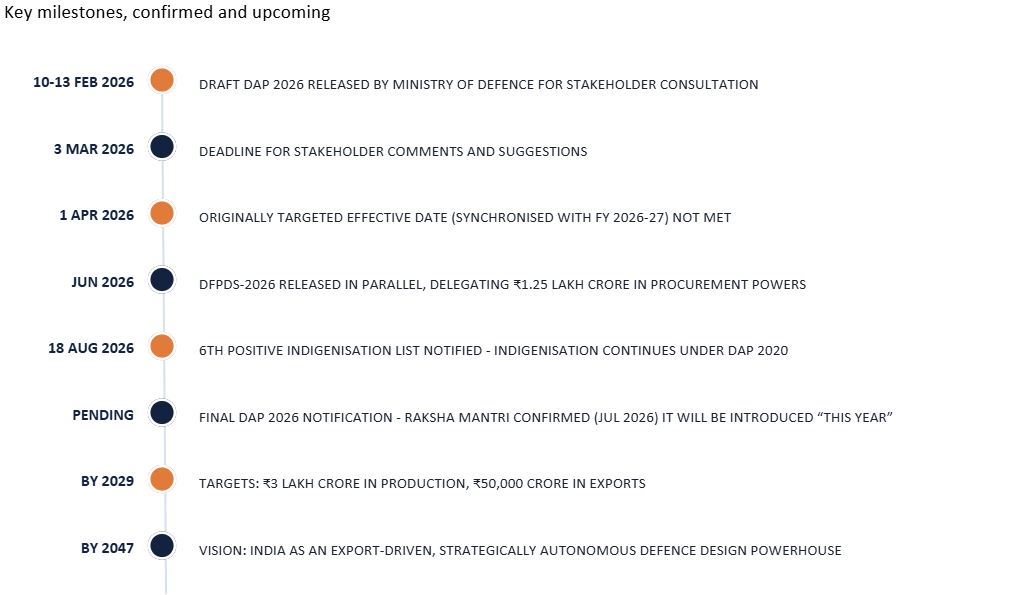
Draft released 10-13 February 2026; still under final review as of August 2026
The Shift
“Made in India” (assembly & manufacturing on Indian soil) is being superseded by “Owned by India” – India retaining source code, critical design data and upgrade authority, positioning the country as a “design powerhouse of the world.”
Where things stand: the draft was expected to take effect from 1 April 2026, but as of August 2026 it remains under review beyond that date. The Defence Minister confirmed in July 2026 that the “new DAP” will be introduced “this year.” In the interim, DAP 2020 continues to govern live procurement cases.
Four Acquisition Categories, TRL-Anchored
TRL 1-5 | Make / Design & Development
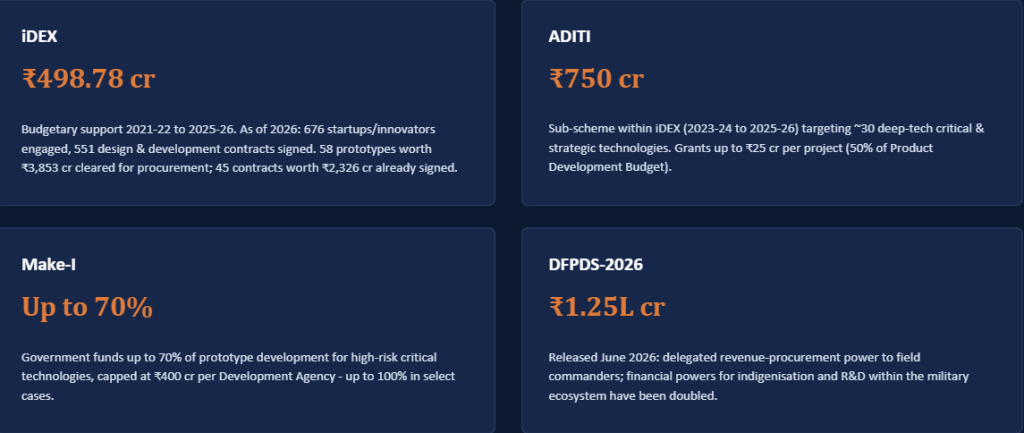
High-risk critical tech prototyping; Make-I funded up to 70% by government, capped ₹400 cr per Development Agency.
TRL 5-9 | Buy (Indian-IDDM)
Indigenously Designed, Developed & Manufactured top procurement preference; 60% indigenous content required.
TRL 8-9 | Buy (Indian) & Manufacture in India
Replaces the earlier standalone ‘Buy (Indian)’ route, which allowed non-indigenously-designed items; now folded in with a manufacture-in-India mandate.
Buy (Global) & Manufacture in India
Foreign-origin systems with mandated domestic manufacture, used only where no mature Indian option exists.
Plus two new fast-tracks: Low-Cost Capital Acquisition (LCCA, capped ₹75 cr/project) for rapid trial-and-induction, and Long-Term Bulk Acquisition (LTBA) for complex, multi-tranche platforms with built-in upgrade paths.
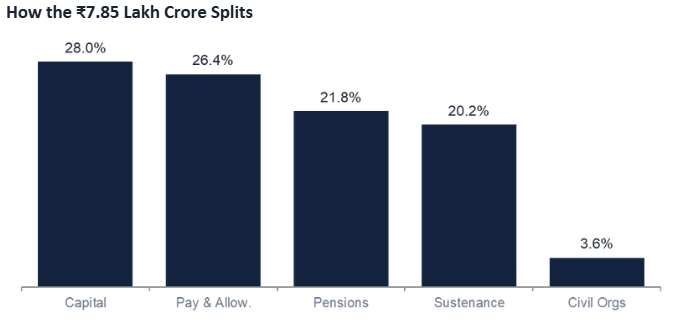
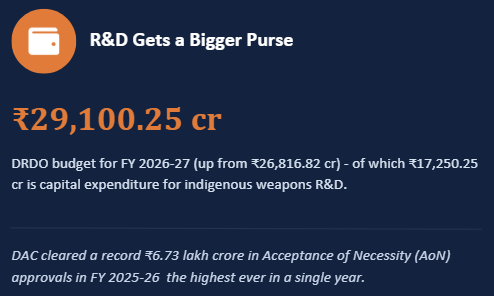
Government Funding: FY 2026-27 Backbone
A record ₹7.85 lakh crore defence budget underwrites the acquisition pipeline DAP 2026 will govern

Funding Innovation, De-Risking Industry
The specific government schemes that put money behind DAP 2026’s startup and MSME push
Compressing the Acquisition Timeline
Process reforms designed to match acquisition speed to technology cycles
Dedicated iDEX / TDF Chapter – Innovations for Defence Excellence and the Technology Development Fund get a standalone acquisition procedure, no longer a branch of ‘Make’.
Minimum Pilot Order Quantity – Once an iDEX/TDF prototype clears trials, the sponsoring Service must place a meaningful-scale pilot order converting prototypes into real contracts.
5-Year Assured Order Guarantee – Successful iDEX and Make projects get demand visibility for five years, easing private capital’s biggest fear: no buyer.
Refined Fast Track Procedure – Delegation of powers moves downward for urgent cases and technologies with short development cycles; two-stage trials tighten timeline monitoring.
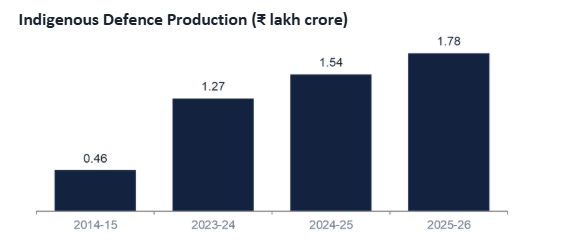
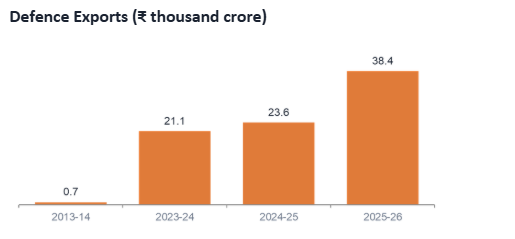
A Decade of Self-Reliance Momentum
DAP 2026 builds on a decade of record indigenous production and exports

What’s Just Happened – August 2026
Indigenisation and modernisation keep moving under DAP 2020, even while DAP 2026 finalises.
18 Aug 2026| 6th Positive Indigenisation List – 405 items notified (389 DPSU, 16 Coast Guard), ₹3,070 cr business potential – taking the six lists together to 5,417 items reserved for Indian industry.
23 Aug 2026|GRSE & Yantra India Expansion – Rajnath Singh inaugurated ₹3,500 cr capacity expansions in West Bengal for warship construction and weapons forging.
Jun 2026 | Turbine Contract from an Indian Company – ₹425 cr order for 12 marine gas turbine generators for Navy vessels, with 60% indigenous content.
Jul 2026 | iDEX Milestone at Drone Conclave – 676 startups/innovators now in the iDEX ecosystem; 58 prototypes worth ₹3,853 cr cleared for procurement, 45 contracts worth ₹2,326 cr signed, Rajnath Singh announced at the National Defence Industries Conclave.
Open Questions Analysts Are Raising
Offset Policy in Limbo – The offset requirement foreign vendors reinvesting into Indian industry is, missing from Volume I and only inconsistently referenced in Volume II.
Renaming vs. Real Reform – Critics note some category changes (e.g., merging ‘Buy (Indian)’ into ‘Buy (Indian) and Manufacture in India’) look cosmetic, with underlying criteria largely unchanged.
Fragmented Institutions – Multiple agencies still run separate chains of command; there is still no single overarching procurement organisation led by acquisition professionals.
Missed Rollout Date – The procedure was expected to take effect from 1 April 2026 alongside the new fiscal year; six months on, it remains unfinalised, leaving industry to plan against DAP 2020 in the interim.
Roadmap: From Draft to Doctrine
DAP 2026 is India’s attempt to fuse three goals that used to pull in different directions: speed, technology leadership and self-reliance, backed by a record ₹7.85 lakh crore budget and ₹1.39 lakh crore ring-fenced for Indian industry. Whether it succeeds will depend less on the categories on paper and more on execution consolidated institutions, honoured timelines, and a private industry confident enough to invest ahead of orders.
- Own the design, not just the assembly line
- Match acquisition speed to technology cycles
- Back it with money: record budgets, ring-fenced domestic spend, doubled R&D financial powers
- De-risk private and startup investment with demand guarantees
- Fix institutional fragmentation and honour the finalisation timeline