
Introduction
For decades, Indian Railways has been known as the lifeline of the nation, moving millions of passengers and vast volumes of goods across geographies. But today, its role is undergoing a fundamental transformation. No longer just a transport utility, railways are emerging as a critical economic enabler, quietly powering India’s industrial momentum, logistics efficiency, and global competitiveness.
This shift is both structural and strategic. As India aspires to become a global manufacturing hub, the focus has moved beyond connectivity to capability, how efficiently the country can move raw materials, finished goods, and energy resources across regions. In this evolving landscape, railways are no longer operating at the periphery they are at the very centre of economic activity, enabling industries to function seamlessly and scale efficiently.
The scale of investment reflects this changing priority. With record capital expenditure, rapid electrification, dedicated freight corridors, and a strong policy push under initiatives like PM GatiShakti, Indian Railways is being reimagined as a modern, integrated logistics backbone. This is not incremental progress, it is a system-wide transformation aimed at improving speed, reliability, and cost efficiency across the supply chain.
At the same time, the ripple effects are being felt across the industrial ecosystem. From steel and cement to electrical equipment and engineering goods, railways are driving demand, strengthening domestic manufacturing, and contributing to India’s push for self-reliance and export competitiveness. More importantly, by improving logistics efficiency, they are directly addressing one of India’s long-standing structural challenges, high logistics costs.
In essence, railways today are doing far more than moving goods, they are enabling growth. They are bridging production centres with markets, reducing inefficiencies, and strengthening India’s position in global value chains. As India moves forward on its journey towards becoming a developed economy, the tracks being laid today are not just physical infrastructure, they represent the pathways of future economic growth.
Scale of Investments & Policy Push
Indian Railways is undergoing one of the most significant transformations in its history, moving beyond its traditional role as a transport provider to becoming a key driver of India’s economic growth. The scale of investment reflects this shift. Annual capital expenditure stands at around ₹2.5 lakh crore in FY25-FY26 and is expected to increase to ₹2.7-2.8 lakh crore by FY27. This consistent rise highlights a strong policy push towards modernisation, capacity expansion, and efficiency improvement.
Importantly, nearly maximum utilisation of capex in FY26 indicates a clear focus on execution, with faster project implementation and improved delivery across the network.
On the infrastructure front, Indian Railways has achieved ~99% electrification of its broad-gauge network, reducing dependence on fossil fuels and improving operational efficiency. At the same time, continued investments in network expansion, track doubling, and capacity augmentation are enabling faster and more efficient movement of both passengers and freight.
Key Policy Priorities Driving Transformation
The current policy direction is focused on large-scale, system-wide transformation rather than incremental upgrades. Key priorities include:
- Dedicated Freight Corridors (DFCs): Development of high-capacity freight routes to improve logistics efficiency and free up passenger lines
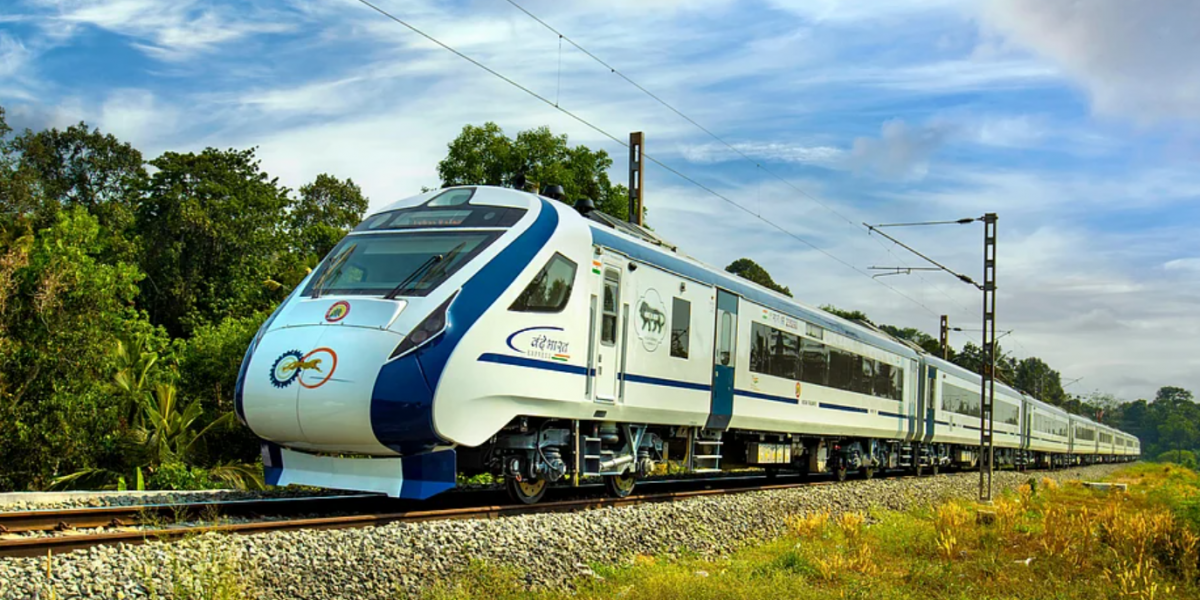
- High-speed & Semi-high-speed Rail:Expansion of the Vande Bharat Express ecosystem for faster and more efficient travel
- Station Redevelopment:Modernisation of stations under the Amrit Bharat Station Scheme to enhance passenger experience and infrastructure quality
- Safety Enhancement:Implementation of the Kavach system to improve safety and reduce accidents
- Digitalisation & Signalling Upgrades: Adoption of advanced technologies for better traffic management, real-time monitoring, and operational efficiency
Indian Railways is clearly shifting from incremental improvements to a holistic transformation, positioning itself as a modern, efficient, and future-ready backbone for India’s growth.
Railways as a Manufacturing Multiplier
Direct Manufacturing Impact
Railways today generate significant manufacturing activity through rolling stock production, large procurement orders, and export growth.
India has achieved record levels of rolling stock production in FY25-FY26, reflecting both capacity expansion and stronger execution:
- ~1,600-1,900 locomotives produced annually
- 6,500+ LHB coaches manufactured in FY26
- ~30,000 wagons produced per year
This scale of production places Indian Railways among the largest integrated rail manufacturing ecosystems globally.
In addition, large-value procurement is further strengthening domestic manufacturing:
- ₹25,000-26,000 crore locomotive orders (high-horsepower freight engines) under Make in India
- Increasing localisation of components such as propulsion systems, braking systems, and electronics
Railways are also contributing to India’s export ambitions, with railway-related exports reaching ~₹24,000 crore, including locomotives, coaches, and components supplied to markets in Africa, Southeast Asia, and Latin America.
Indirect Industrial Linkages
Beyond direct manufacturing, Railways act as a multiplier across core industries, driven by sustained capital expenditure and infrastructure expansion.
Steel & Metals: Railways are one of the largest consumers of steel in India, supporting demand for rails, wagons, bridges, and structural infrastructure
Electrical Equipment: With ~99% electrification of the broad-gauge network, demand has significantly increased for transformers, cables, overhead equipment, and signaling systems
Engineering Goods: Continuous demand for heavy engineering components, traction systems, castings, forgings, and railway subsystems
Construction Materials: Large-scale consumption of cement and aggregates driven by Track doubling and new lines, Station redevelopment and Dedicated Freight Corridors (DFCs)
Scale Effect on Industrial Demand
The multiplier effect is further amplified by the scale of railway operations and expansion:
- ~₹2.5 lakh crore annual capex (FY25-FY26) driving sustained industrial demand.
- Freight loading of ~1.6-1.7 billion tonnes in FY26, necessitating continuous expansion of wagons, tracks, and logistics infrastructure.
- Ongoing investments in DFCs, station redevelopment, and network expansion.
Logistics Transformation & Cost Competitiveness
India’s logistics cost, estimated at ~13-14% of GDP, has historically been higher than global benchmarks (~8-10% in developed economies). Reducing this gap is critical for improving India’s manufacturing competitiveness, and Indian Railways is at the centre of this shift.
Freight Scale & Growth Momentum
Indian Railways has significantly expanded its freight role, supporting core industrial sectors:
- ~1.67 billion tonnes freight loading in FY26 (record level)
- Freight share strengthening in key commodities:
- Coal (~45-50% share of freight loading)
- Iron ore, steel, cement, fertilisers as major growth drivers
This scale highlights Railways’ position as the backbone of bulk logistics in India.
Dedicated Freight Corridors (DFCs)
The rollout of Dedicated Freight Corridors is fundamentally changing logistics efficiency:
- 2-3x increase in average freight train speeds
- Reduction in transit time by ~30–40% on key routes
- Improved reliability and predictability of deliveries
- Faster wagon turnaround, increasing asset utilization
In addition, DFCs are enabling:
- Longer and heavier trains (higher axle loads)
- Seamless movement between industrial clusters, ports, and consumption centres
Shift Towards Rail-led Multimodal Logistics
India is gradually transitioning from a road-dominated logistics model (~60% share) to a more balanced, efficient system:
Increasing shift towards rail + road multimodal logistics
Focus on:
– Bulk cargo movement via rail
– Containerisation for non-bulk and high-value goods
Integration with:
– Industrial corridors
– Logistics parks (PM Gati Shakti framework)
– Ports and export hubs
Impact on Manufacturing & Key Sectors
Lower logistics costs and improved efficiency are directly benefiting manufacturing sectors:
- Steel & Metals: Faster and cheaper movement of raw materials (iron ore, coal) and finished steel
- Cement: Improved long-distance movement, expanding market reach for manufacturers
- Automotive & Engineering Goods: Growing use of containerized rail for finished goods and components
- Fertilizers & Chemicals: Efficient bulk movement across regions, supporting agricultural and industrial demand
- Export-oriented sectors: Better connectivity to ports improves global competitiveness
Railways & National Competitiveness
Manufacturing Competitiveness
- Logistics cost: ~13-14% of GDP (vs. ~8-10% globally)
- Rail offers lower cost per tonne km, especially for bulk transport
- Supports core sectors: steel, cement, auto, engineering
- Backed by ₹2.5-2.8 lakh crore annual capex
Regional Industrialization
- Expands connectivity to tier 2/3 cities
- Links resource hubs, industrial clusters, and markets
- DFCs enabling corridor-based industrial growth
Sustainability
- ~99% electrification of broad-gauge network
- Rail has significantly lower emissions vs road
- Enables modal shift (road to rail)
Supply Chain Resilience
- ~1.67 billion tonnes freight (FY26)
Dedicated Freight Corridor benefits:
- 2-3x faster movement
- 30-40% lower transit time
- Higher reliability
National Integration
- PM Gati Shakti supports integrated multimodal infrastructure planning
- Viksit Bharat 2047 positions railways as a long-term growth backbone
- Net Zero goals emphasize sustainable transport systems
Railways at the Core of India’s Growth Flywheel
India is transitioning towards a connected economic growth model, where: Infrastructure enables logistics, logistics supports manufacturing, manufacturing drives exports, and exports fuel economic growth.
At the centre of this flywheel is Indian Railways, linking large-scale investments to tangible economic outcomes across sectors.
Railways Anchoring the Growth Chain
Infrastructure Scale: Sustained capital expenditure of ₹2.5-2.8 lakh crore (FY25-FY27) is driving network expansion, capacity augmentation, and near-complete electrification
Logistics Backbone:
~1.67 billion tonnes freight loading (FY26), with Dedicated Freight Corridors enabling:
- 2-3x faster freight movement
- 30-40% reduction in transit time
- Improved reliability and asset utilisation
- Manufacturing Multiplier ~1,900 locomotives (FY26, record level)
- 6,500+ coaches and ~30,000 wagons annually
- ~₹24,000 crore railway exports, supporting global market presence
Sustainability Driver: ~99% electrification of the broad-gauge network, enabling significantly lower emissions compared to road transport
Railways Driving India’s Growth
Emerging Reality
- Transition from the “lifeline of India” to the “growth engine of India”
- Shift from a cost centre to a value creator, driven by:
- High freight volumes and efficiency gains
- Lower logistics costs (~13-14% of GDP)
- Stronger supply chain reliability
- Rising industrial and export competitiveness
Strategic Insight
Indian Railways is now a system-level economic enabler, delivering multi-sector impact:
- Industrial Growth: Supporting core sectors such as steel, cement, and engineering
- Export Competitiveness: Lower logistics costs and improved turnaround times
- Regional Development: Expanding connectivity to tier-2 and tier-3 markets
- Sustainability: Driving modal shift and enabling low-carbon transport
Government Initiatives & Policy Direction
- PM Gati Shakti enabling integrated, multimodal infrastructure planning
- Dedicated Freight Corridors (DFCs) driving logistics efficiency and corridor-led industrialisation
- Make in India & PLI schemes strengthening domestic manufacturing ecosystems
- Station redevelopment and modernization under national programmes improving infrastructure quality
- Strong alignment with Viksit Bharat 2047 and Net Zero goals, positioning railways as a long-term economic and sustainability backbone