
Ethanol, biodiesel, SAF and biogas
Preamble
Biofuels offer India a pathway to reduce dependence on imported petroleum, use domestic resources and convert waste into energy. The National Policy on Biofuels supports this approach by encouraging production from a wider range of feedstocks, including agricultural residues, used cooking oil and specified crop-based materials.
Ethanol and biodiesel support fuel blending in road transport, SAF provides a pathway for aviation, and biogas connects organic waste management with energy generation. Together, these segments create opportunities across agriculture, fuel production and industrial infrastructure. This document examines their role in India, with a focus on policy support, feedstock availability and commercial viability.
The opportunity also extends to technology, equipment and project development. India’s support for advanced biofuels under the PM JI-VAN Yojana encourages the use of agricultural and forestry residues and other renewable feedstocks, creating scope for engineering and processing solutions that turn these materials into fuel.
Long-term growth will depend on reliable feedstock supply, suitable technology, financing and infrastructure. Assessing these factors alongside market demand is essential to understanding how India’s biofuel potential can translate into commercially viable projects.
Executive summary
- Ethanol reached E20 – 20% average blending achieved in ESY 2025-26 (Nov-June data); the original 2030 target was advanced to 2025-26.
- 2026 moves beyond E20 – E85 is for certified flex-fuel vehicles. This does not change the nationwide E20 petrol blend.
- Feedstock is the constraint – Feedstock availability and price matter. Treat grain-share and sugar-diversion figures as provisional unless tied to a dated primary release.
- Other fuels catch up – Biodiesel remains at an early stage; India has indicative SAF targets and a new ₹23,731 crore CBG scheme.
The ethanol programme in numbers
– 20%: Average ethanol blending achieved during ESY 2025-26 (November–June), compared with approximately 1.53% in 2013-14.
– 1,953 crore litres: Installed ethanol production capacity as of 31 October 2025. The government subsequently reported a capacity of approximately 2,000 crore litres in 2026.
– 5%: GST rate applicable to ethanol supplied for the Ethanol Blended Petrol (EBP) Programme.
– ₹1.44 lakh crore: Cumulative foreign-exchange savings reported up to July 2025, rather than savings generated during ESY 2025 alone.
Biofuel types and India’s status
| Fuel | Typical feedstock | India: status / policy |
| Bioethanol | Sugar-based feedstock, maize, damaged / surplus grains, biomass | E20 achieved in 2025-26; no decision to raise nationwide blend above 20% |
| Biodiesel | Used cooking oil, animal fats, non-edible oils | Policy supports blending; actual uptake remains limited |
| Sustainable aviation fuel (SAF) | Waste oils, residues and other eligible pathways | Indicative targets for international flights: 1% in 2027, 2% in 2028, 5% in 2030 |
| Compressed biogas (CBG) | Cattle dung, press mud, crop residue, organic municipal waste | CBG obligation: 3% FY27, 4% FY28, 5% from FY29 in CNG/PNG segments |
| Advanced / 2G biofuels | Agricultural residues and other lignocellulosic biomass | PM JI-VAN supports eligible advanced biofuel projects; check current scheme rules |
Policy timeline

Ethanol feedstock
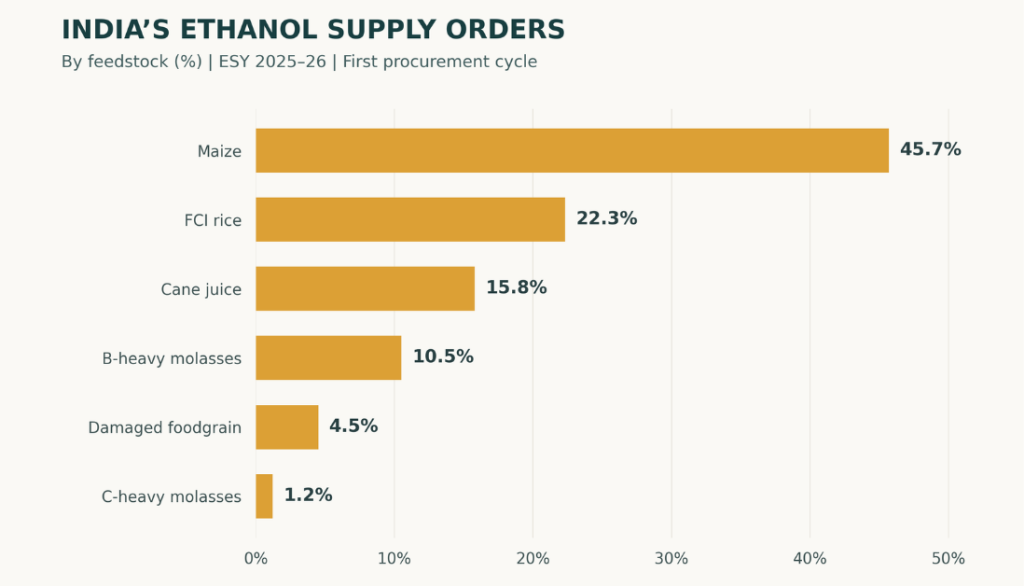
Ex-mill price – Prices vary by feedstock and procurement cycle.
Actual supply – Allocation is not the same as actual supply. A dated primary-source series is needed before comparing realised deliveries by feedstock.
Beyond E20: what is confirmed
Standards – Fuel specifications & E85 availability should not be read as a national mandate to move petrol blends above E20. The government has said no decision has been taken.
E85 and flex-fuel – E85 is intended only for flex-fuel vehicles designed & certified for it.
Do not generalise outlet rollout or vehicle launch claims without a primary release.
Target – A higher aggregate biofuel share by 2030-31 is a projection, not a confirmed nationwide petrol-blending mandate. SAF and CBG have separate trajectories.
What is decided and what is not
| Question | Verified position as Oct 2026 |
| Mandatory petrol blend above E20? | No decision taken. |
| E22 / E25 / E27 / E30 nationwide targets? | Do not present as national targets without a specific official notification. |
| E85 for all petrol vehicles? | No. E85 is for flex-fuel vehicles designed and certified for that fuel. |
| Vehicle compatibility with E20? | Follow manufacturer guidance; compatibility can vary by model and age. |
Biodiesel: policy support, limited scale
– 5%: Indicative biodiesel blending target in diesel under the National Policy on Biofuels. This represents a policy target, not an indication of the blending level currently achieved.
– 5%: GST rate applicable to biodiesel procured for the blending programme, reduced from the earlier rate of 12%.
Government measures include biodiesel sale guidelines (2019), lower GST for blending procurement, an expanded list of eligible feedstocks & PM JI-VAN support for advanced biofuels.
Sustainable aviation fuel (SAF): India’s indicative roadmap
- 1% by 2027: Indicative Sustainable Aviation Fuel (SAF) blending target for international flights.
- 2% by 2028: Indicative SAF blending target for international flights.
- 5%: Longer-term indicative SAF blending target.
India amended the ATF Control Order in April 2026 to include SAF-blended aviation fuel. Indian Oil Corporation Limited’s (IOCL) Panipat refinery has received ISCC CORSIA certification, which verifies that SAF meets the sustainability requirements recognised under the International Civil Aviation Organization’s (ICAO) Carbon Offsetting and Reduction Scheme for International Aviation (CORSIA). However, project economics, feedstock availability and certification requirements remain key factors in scaling up SAF production and adoption.
Compressed biogas gets a national scheme
– ₹23,731 crore: The Union Cabinet approved the GOBARdhan scheme on 6 August 2026, and it was officially launched on 1 October 2026. The scheme will be implemented over a ten-year period, from FY 2026-27 to FY 2035-36.
– Implementation status as of 13 August 2026: A total of 217 plants had been commissioned, producing approximately 0.4 million metric standard cubic metres per day (MMSCMD) of biogas. Another 357 plants were under construction.
– Production target: The scheme aims to increase domestic biogas production capacity by nearly ten times.
Key challenges and debates
Food vs Fuel– Balancing fuel demand with food security and affordability matters as grain-based ethanol expands.
Maize Market – Feedstock costs & availability shift with crop output, trade & competing uses.
Water – Lifecycle emissions & water use depends on feedstock, process efficiency, energy source & local conditions.
Vehicles – Fuel economy and compatibility vary by vehicle design, calibration and model year; avoid one figure for all vehicles.
Sugar Economics – Sugar-based ethanol availability is sensitive to rainfall, cane output & government feedstock-allocation policy.
Spare Capacity – Installed capacity is not the same as operating output or deliverable supply; utilisation and logistics matter.
Outlook and what to watch
Next 6 months : Track ESY 2026-27 OMC allocations, feedstock rules, actual blending, plant utilisation and changes to scheme eligibility.
2027 : SAF indicative target: 1% for international flights in 2027. CBG obligation: 3% in FY 2026-27 and 4% in FY 2027-28.
By 2030-31 : SAF indicative targets rise to 2% in 2028 and 5% in 2030; CBG obligation reaches 5% from FY 2028-29 in CNG/PNG.
Government incentives: ethanol and advanced biofuels
EBP procurement and pricing – Oil Marketing Companies procure ethanol under the Ethanol Blended Petrol programme. Administered prices by feedstock provide a demand framework; rates change by supply year and notification.
GST relief – GST on ethanol supplied for the EBP programme is 5%. This is a tax measure, not a direct cash grant to every producer.
Cooperative sugar-mill interest support – A dedicated scheme supports conversion of existing sugarcane-based ethanol plants to multi-feedstock plants. Eligible loans receive subvention at 6% p.a. or 50% of actual interest, whichever is lower, for five years, including a one-year moratorium.
PM JI-VAN Yojana – Amended in 2024; supports eligible advanced biofuel projects using lignocellulosic biomass and other renewable feedstocks. Timeline extended to FY 2028-29; check current notified eligibility and funding windows.
Government incentives: CBG, biodiesel and enabling policy
- GOBARdhan: ₹23,731 crore FY 2026-27 to FY 2035-36. Eligible greenfield CBG projects can receive capital assistance up to ₹2 crore per tonne/day of installed capacity, subject to scheme rules.
- Assured demand and price framework CBG obligation: 3% in FY27, 4% in FY28 and 5% from FY29 for CNG (transport) and PNG (domestic). Administered price framework: ₹2,110/MMBTU (about ₹105/kg).
- Pipeline and credit support GOBARdhan supports pipeline infrastructure and a credit-guarantee mechanism with coverage up to 85% for eligible loans to MSME-based CBG projects, subject to scheme conditions.
- Biodiesel and waste-to-energy GST on biodiesel procured for blending was reduced from 12% to 5%. MNRE’s Phase-I National Bioenergy Programme ran through FY 2025-26; confirm any successor window before assuming CFA remains open.